
Daily walks are an important part of your dog’s health and wellbeing, but they’re not the only option. Whether your dog needs plenty of exercise or you’re looking for something different, switching up your routine can be a fun way to try something new together.
Dog exercise: Alternatives to dog walking

Dog exercise is crucial for your pet’s mental and physical health – but that doesn’t have to mean endless dog walks around the block. Here are four fun alternatives to walking your dog.
Why variety matters for dog exercise
Just like us, dogs can get bored doing the same thing repeatedly. While regular walks are important, finding alternative dog activities to entertain and exercise your pet can add novelty and enrichment.
Think about what your dog loves. Do they enjoy the physical challenge of trying something new? Or perhaps they can run for hours without getting tired?
Personalising your dog’s activity to their personality and preferences can help them enjoy exercise more and provide the bonding time you both need.
Four alternatives to dog walking
From trying a new competitive sport to a relaxing swim, here are four fun dog activities to try.
1. Competitive sports
Competitive sports are a great way to combine physical movement with mental stimulation. Some options include:
- Agility: A fast-paced, mentally stimulating sport where dogs navigate an obstacle course of jumps, tunnels, ramps and more. Handlers guide their dogs through the course, with winners determined by who completes the course in the fastest time with the fewest penalties.
- Flyball: A high-energy, high-speed sport that’s ideal for energetic dogs that love to play fetch. Two teams of handlers race their dogs against each other in parallel racing lanes, jumping over hurdles and retrieving a ball, which each dog must bring back to the starting line before the next dog sets off.
Many breeds of dog enjoy competitive sports, but they’re particularly well suited to energetic, intelligent breeds such as Border Collies, Cocker Spaniels and Jack Russell Terriers.
‘Engaging in competitive sports with your dog is a fantastic way to stimulate their mind and body while strengthening the bond between you,’ says dog behaviourist, Nick Jones. ‘Before starting, consult your vet to ensure a sound body. Dogs aged 12 to 18 months onwards are generally better suited for these activities, but ensure your dog is fit, strong and healthy beforehand. Remember to gradually increase their time and exposure to these activities to prevent strain or injury.’
While you have the option to compete in these sports officially, you can also practise them at home. If you wanted to create your own obstacle course, you could buy dog exercise equipment and agility items such as weave poles, jumps and tunnels – but there are also plenty of things you can make yourself.
A long piece of plywood held off the ground by some bricks makes a great balance beam, while an old coffee table can be used as a ‘pause table’ – as long as it’s stable, sits low to the ground and is safe for your dog to use.
If your garden isn’t big enough to host your own obstacle course, why not practise with your dog at one of Petplan’s Adventure Parks? These include a range of agility equipment, such as ramps, tunnels, jumps and platforms.
2. Swimming
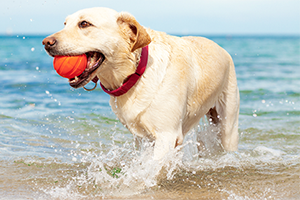
Swimming is an excellent form of exercise for dogs, and 20 minutes of swimming is equivalent to an hour of traditional exercise. Swimming also offers other benefits: the extra resistance provided by water means your dog will be working harder than usual, so they’ll burn more calories.
Because swimming is low-impact, it’s gentle on your dog’s joints. This makes it an excellent choice for dogs of all ages, including senior dogs or those with joint issues such as arthritis.
As an alternative to dog walking, try finding a local dog-friendly swimming pool, or take your dog to a beach, lake or river. Just make sure to check the rules around whether dogs can be let off lead, wherever you go.
Finally, keep your dog safe while swimming by avoiding rough seas, canals, reservoirs and fast-flowing rivers.
3. Playing games
Spice up your daily walks by introducing some games. Take a frisbee and play fetch, or have a game of tug using a tough piece of rope. Games like these don’t come naturally to all dogs, so training is key.
See which games your dog enjoys most and pick activities based on them. For indoor dog exercise ideas, some dogs love playing hide-and-seek, while others prefer sniffing out treats in a puzzle feeder or a snuffle mat.
Even if these games don’t seem as physical, they provide plenty of mental stimulation, which is just as important as physical activity.
4. Running
If your dog is an energetic breed, they might be an ideal running buddy. Start with a gentle jog to improve your dog’s fitness, and if they enjoy that, you could try CaniX – cross-country running with your dog.
To get started, you’ll need a dog harness – such as a Canicross harness – and a special belt worn around your waist. This attaches to your dog’s harness, leaving your hands free and preventing jolting.
Start by aiming to complete 30 minutes of walking, then build up to running for 30-40 minutes (approximately 5km). If you both enjoy this, you can consider participating in CaniX events held across the country.
Dog exercise tips
No matter which activity you choose, keep things fun and safe by:
- Introducing new activities slowly
- Watching out for signs of stress or discomfort
- Tailoring activities to your dog’s age, fitness and health
- Giving your dog plenty of positive praise as they try something new
Before starting any dog walking alternatives, it’s a good idea to speak with your vet. They’ll be able to check your dog’s health and advise against any activities you shouldn’t try. For example, if your senior dog has hip dysplasia, high-intensity exercise such as running or agility wouldn’t be recommended.
Alternatively, if you have Petplan dog insurance with Petplan, log in to your My Petplan account and connect with a vet professional to ask any questions.
Found this article useful? Want to see similar content and engage with like-minded dog owners? Follow us on Petplan’s Facebook page.
Related articles






.jpeg)

Follow us

Petplan is a trading name of Pet Plan Limited (Registered in England and Wales with company number 1282939) and Allianz Insurance plc (Registered in England and Wales with company number 84638).
Pet Plan Limited is authorised and regulated by the Financial Conduct Authority. Financial Services reference number 311969. Allianz Insurance plc is authorised by the Prudential Regulation Authority and regulated by the Financial Conduct Authority and the Prudential Regulation Authority, reference number 121849. Registered address: 15 Bishopsgate, London, EC2N 3AR.