
Read it in 4 minutes
7 top myths about dogs
Expert approved

Expert approved

Over time, various theories have emerged about dogs, which are often accepted as fact, without being examined further. So what is true and what is just a common dog myth? With the help of our pet behaviourist, Nick Jones, and our veterinary expert, Brian Faulkner, we go in search of the truth.
Quick Links
1. A wet nose means a healthy dog
External Video Content

Youtube is not available due to your cookie preferences.
As a rule, we all know that a wet nose is a good sign that your dog is healthy. Dogs often lick their own noses, or produce mucus to coat their nose. This, in turn, aids their sense of smell. The mucus on a dog’s nose helps to absorb smell chemicals, so if a dog is trying to lock on to a specific scent, it helps them track that little bit better. Additionally, as many dogs’ noses are so close to their mouths, they can get dirty quite easily, especially when eating, so dogs will often lick their nose to clean it.
There is a misconception, however, and that is if your dog’s nose is dry, it means something is wrong. In reality, some dogs simply don’t produce as much mucus or lick their nose as much. Or maybe they’re just born with drier noses. The only time you should worry about your dog’s nose is if you notice a different-coloured discharge. If it’s green, red or off-colour in any way, then you should consult a vet to make sure everything is okay.
2. Brushing a dog's teeth is pointless
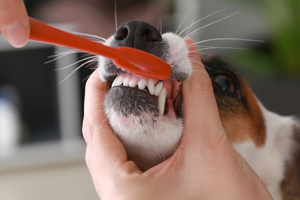
Brushing your dog’s teeth actually has many benefits – it not only freshens your dog’s breath, but also limits the risk of oral disease. It also gives you a chance to notice anything unusual happening to teeth and gums, and ensure abnormalities are caught early. Consult with your vet to get the best advice about dental care.
3. You can't teach an old dog new tricks
External Video Content
Youtube is not available due to your cookie preferences.
We’ve all heard the phrase ‘you can’t teach an old dog new tricks’, but how much truth is there to this old adage? Not a lot, to be honest! While the phrase itself has existed in some form or another since the 1500s, it actually has very little bearing on reality.
In truth, it may be more difficult to teach an older dog some new tricks, in much the same way as when we get older, we have difficulty learning new things as our behaviours stick and our minds become less malleable. Teaching an old dog is no different to teaching a younger pup, however – by starting with short training sessions and slowly and sensibly increasing the duration, it’s very possible to teach your dog a new trick, no matter how old they are.
4. Letting my dog out in the garden is plenty of exercise
A healthy dog requires mental stimulation and human interaction as well as exercise, so simply letting them out into your garden is not enough in terms of exercise.
Though different-sized dogs will require different levels of physical activity, is it essential for any dog’s wellbeing that it is taken for walks and played with. It’s also this interaction that makes having a dog such an amazing and worthwhile experience for you!
5. Dogs who eat grass are unwell
External Video Content
Youtube is not available due to your cookie preferences.
‘Dogs only eat grass because they’re feeling sick’ is another piece of knowledge that we take for granted as an absolute truth, but again, it’s not that simple. While some dogs will be sick from eating grass, there doesn’t seem to be any particular reason as to why they’ve elected to eat grass in the first place. In fact, only about 25% of dogs who do eat grass will induce vomiting.
So, why do dogs eat grass? While there doesn’t seem to be any particular connection between eating grass and the health of your dog, unfortunately we don’t know much more. It could be due to the dogs thinking they’re sick, perhaps they need a nutrient they can only get from grass – or perhaps they simply enjoy it!
We learn more and more about our animal friends with each passing year, so maybe one day we’ll finally be able to answer this age-old quandary, but, until then, your dog eating grass is no major cause for concern.
6. Dogs are colour-blind
This is true – but only to a certain extent.
Dogs don’t see the full range of colours that we see – they are actually believed to be red-green colour-blind. This means your dog may have trouble differentiating between a red toy and a green toy, but that’s about the extent of it.
The myth that dogs see in black and white is just that – a myth.
7. Dogs wag their tail when they're happy
This can sometimes be true, but not always.
Dogs wag their tail for many reasons and, while this could mean that they are happy, this behaviour can just as easily indicate fear or stress.
Learning to read what your dog is telling you from a range of indicators – not just the wagging of their tail – will go a long way towards maintaining a good relationship.
Dr Brian Faulkner

Nick Jones MA

Related articles











Follow us

Petplan is a trading name of Pet Plan Limited (Registered in England and Wales with company number 1282939) and Allianz Insurance plc (Registered in England and Wales with company number 84638).
Pet Plan Limited is authorised and regulated by the Financial Conduct Authority. Financial Services reference number 311969. Allianz Insurance plc is authorised by the Prudential Regulation Authority and regulated by the Financial Conduct Authority and the Prudential Regulation Authority, reference number 121849. Registered address: 15 Bishopsgate, London, EC2N 3AR.